Prisons Museum
2017 — OngoingPrisons Museum grew from a practical question: how can the physical, documentary and human traces of detention be preserved before they disappear, and how can those traces be connected without forcing them into a single source or narrative?
An investigative museum documenting detention systems through places, records and survivor testimony. Its work includes the ISIS Prisons Museum, Syria Prisons Museum and Jawab.
- Role
- Founder & Director
- Period
- 2017 —
The project is developed collaboratively. Consult each original work for full team credits.

Question and approach
The work began in 2017 with documentation of prisons and detention sites and the archive that would later develop into the Prisons Museum. In 2024, the Prisons Museum was publicly launched as a specialised project while its institutional structure was developed and preparations began for legal registration in Germany. In 2025, Prisons Museum e.V. was registered in Berlin as an independent legal entity. Former detention sites contained names scratched into walls, physical traces, records and local memories that were already at risk of being lost, looted, demolished or absorbed into new uses.
The question gradually moved from the fate of a single person to the structure of detention itself: how a site functioned, who moved through it, how an order became a procedure, and what could be learned by reading a building together with testimony and records. The method therefore developed across site investigation and forensic photogrammetry, document and testimony archives, 3D reconstruction, investigative research and databases that map relations between people, places, documents and events.
The museum is not the end point of this process. It is one public form the research can take. The same body of evidence can also support families searching for the missing, journalistic and academic research, legal accountability and longer-term public history. The methodology is survivor-centred: consent, dignity, security and the ability of survivors to shape how their knowledge is used are part of the evidentiary process itself.
Role in the work
Matar founded the institution and leads its investigative and editorial direction. The methodology itself is collective: it is developed and carried out with journalists, field documentarians, architects, archivists, technologists, researchers, lawyers and survivor communities.
How knowledge is built
Institutional structure
Recent related material
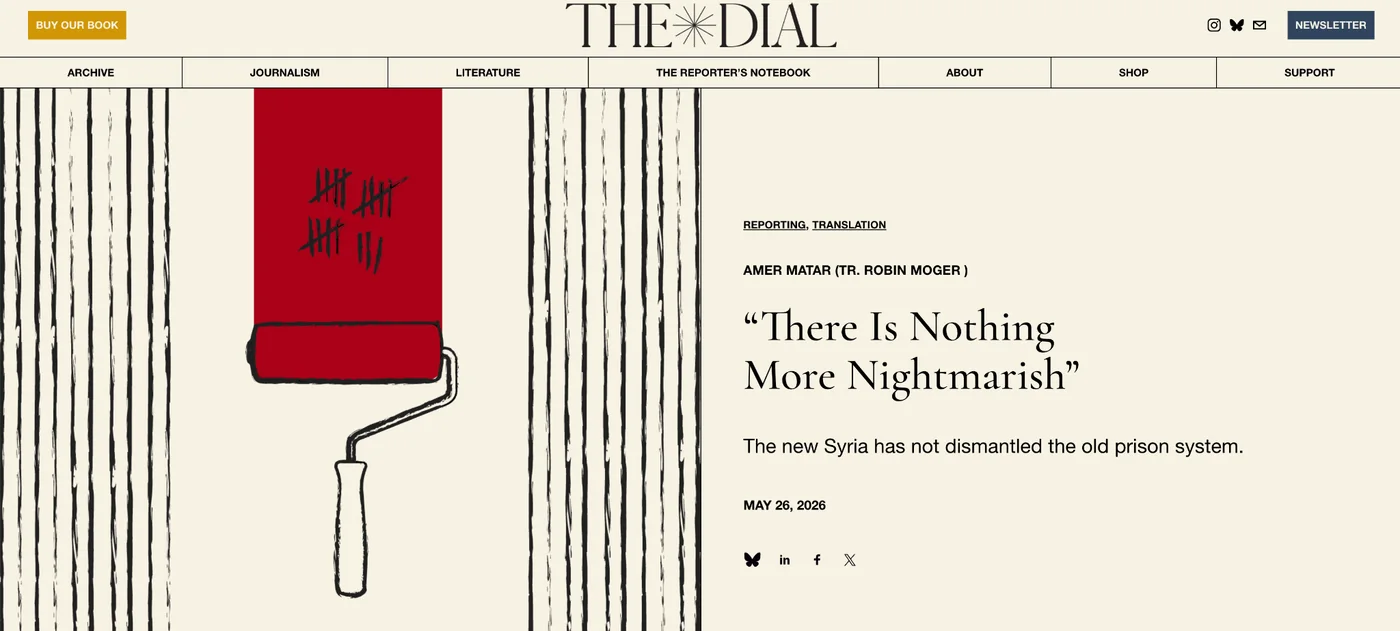
“There Is Nothing More Nightmarish”
Reporting on the reuse of former detention sites after the fall of Assad, the persistence of arbitrary detention, and his own detention at the Syrian–Lebanese border. Translated by Robin Moger.
The Dial
Prisons Museum Poster Exhibition
Poster exhibition within the Syria in Transition series, 18 February–10 March 2026.
Goldsmiths, University of London
Documentary Theatre Event on the Hisba Diwan and Assad’s Prisons
Rumaila Prison and the Khatib Branch presented through testimony and spatial reconstruction.
HAU Hebbel am Ufer · Berlin
Seminar zur autoritären Herrschaft und politischen Inhaftierung in Syrien
gw.uni-jena.de